
01
Comprehensive exam
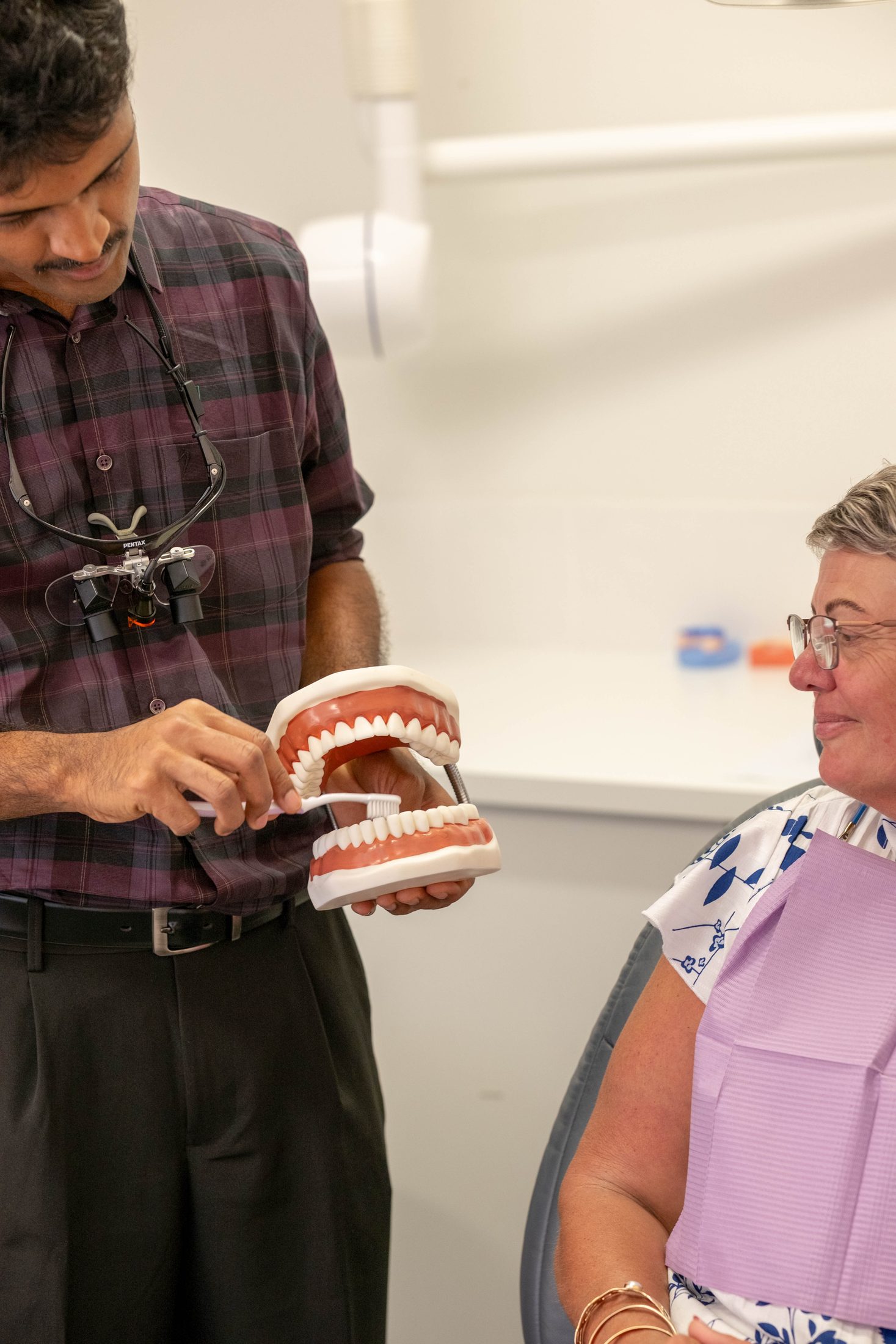
A structured visual and tactile check of every tooth, all gum margins, your bite, and the soft tissues of your mouth. Magnification where it helps.
15 minutesYou know the one. The visit you've been meaning to book for months. Thirty to forty-five minutes in the chair, an honest look at what's going on, a clean, and a plain-English plan before anything else starts. For HBF and Bupa members on extras, eligible preventive services may attract benefits — bring your card and reception can help with a HICAPS estimate once item numbers are known.
A good check-up is uneventful. That's the point. Twice a year, about forty-five minutes in the chair, and you walk out with a clean mouth, a clear plan, and — for most people, most of the time — nothing else to do. That's the quiet victory this visit is designed for.
Plaque mineralises into tartar over time. Once it has set, your toothbrush can't remove it. Left alone, it irritates the gums, invites inflammation, and over years quietly erodes the bone that holds your teeth in place. Around 30% of Australian adults are living with moderate to severe gum disease and most of them have no idea. Early oral cancer changes start the same way — silent, unnoticeable, until they aren't. A check-up is the one window where every one of these gets looked at.
You'll get magnification, digital X-rays when they're due, a full soft-tissue screen, and the oldest diagnostic tool in the profession — a dentist who actually looks. Dr Jignesh Vania and Dr Geoff Noonan see the same Geraldton families twice a year, year after year, which means they notice change. No sales pitch. No clock running.
Come when you're ready. That might be this month. It might be after a year away. Whenever it is, you won't be told off for how long it's been — we'll just pick up where you are and go from there.
Six things happen in your 45-minute visit. Nothing is optional, nothing is an upsell — it's simply what a proper check-up looks like.
A structured visual and tactile check of every tooth, all gum margins, your bite, and the soft tissues of your mouth. Magnification where it helps.
15 minutesDigital dental X-rays help us diagnose issues early with low-radiation imaging technology. Shown on-screen beside you when clinically indicated.
If due — 5 minA two-minute visual and manual check of lips, tongue, floor of mouth, palate, and neck lymph nodes. Early detection saves lives.
2 minutesUltrasonic scaling removes hardened plaque above and below the gum line — the stuff your toothbrush can never reach, no matter how well you brush.
15 minutesProfessional polish to remove surface staining from tea, coffee, wine and tobacco, and to leave enamel smoother so new plaque struggles to stick.
5 minutesFluoride varnish where clinically indicated, personalised brushing and flossing pointers, and a written plan for anything we've flagged — with a HICAPS quote before you agree.
5 minutesHere's exactly what happens in the chair, and why each step matters. Read before you book — or bring a nervous friend and read it together.
Most of a dentist's diagnostic skill comes from what they can see and feel — not from machines.
A thorough dental exam is a structured walk through your entire mouth. We don't just "look at your teeth" — we're checking dozens of specific things, most of which have nothing to do with cavities.
We assess each tooth for decay (including tiny early lesions hidden between teeth), fractures, wear facets from grinding, and any failing restorations — old fillings, crowns, or bridges that may be leaking or breaking down. Around the gums, we measure pocket depths in millimetres, look for recession, and check for bleeding on gentle probing — an early signal of inflammation.
Then we check how your teeth come together: the bite, any TMJ tenderness, signs of clenching or grinding. And finally a full pass of the soft tissues — tongue, cheeks, palate, floor of mouth, lips — looking for anything that shouldn't be there.
Digital imaging is used only when there is a clinical reason, with the image shown beside you on screen.
Eyes and mirrors only get us so far. About 40% of every tooth's surface is hidden — either between two teeth where they touch, or below the gum line. X-rays are the only way to check those surfaces properly.
Digital dental X-rays help us diagnose issues early with low-radiation imaging technology. They give instant results and let us zoom in and annotate images on a screen while we explain what we're looking at. You'll see your X-rays the moment they're taken.
How often depends on your personal risk. Adults with no history of decay and good gum health: every 2 years is standard. Patients with recent cavities, deep fillings, or gum disease: yearly or more often. Children: usually at longer intervals, only when clinically indicated. We never X-ray just because "it's due" — there needs to be a reason.
Tartar forms in 24–48 hours and sets like cement. No home tool can remove it.
Plaque — the soft film that builds up on teeth every day — mineralises into tartar (calculus) in 24 to 48 hours. Once it's tartar, brushing, flossing, mouthwash and water flossers can't shift it. Only a professional scale can.
We use an ultrasonic scaler, which vibrates at high frequency to break the bond between tartar and enamel without damaging the tooth underneath. Water flushes the debris away continuously. We access both above and below the gum line, because the tartar that matters most — the kind that causes gum disease and bone loss — is the stuff you can't see.
For patients with more than average build-up, we may split the clean across both sides of the mouth or recommend a follow-up visit. You should never leave with tartar we couldn't finish. And if your gums are inflamed and bleed during scaling, we'll explain why, recommend the right home-care adjustments, and bring you back for a check-in.
No decisions under pressure. Nothing gets done today that we haven't quoted and talked through first.
The last ten minutes is the part of the visit that actually matters most — when we sit with you, out of the chair, and walk through what we found. No jargon. No scare tactics. No same-day upsell.
If everything looks good, we tell you that plainly and book you back in six months. If we spotted something — a small cavity, mild gum inflammation, a worn spot from grinding — we explain what it is, what's likely to happen if it's left, and what the treatment options look like. Usually there's more than one, and usually one of them is "watch and review in three months".
Whatever we recommend, you'll leave with it written down — a plain-English plan you can take home, sit with, show your partner, and come back to when you're ready. For anything with a cost, your HICAPS estimate is run at reception so you know exactly what your fund will cover and what the gap will be, before you book in. Nothing starts until you've agreed.
You'll sit beside Geraldton locals, FIFO workers home for the week, second-generation families, and kids on their first visit. The chair fits everyone. Three situations come up again and again — here's what each one looks like with us.
Tell reception when you book. You'll get longer in the chair, a stop signal agreed up front, and every step explained before it starts. Music, if it helps. You set the pace — we don't push past it.
You'll count their teeth together, ride the chair up and down, look in the little mirror. The goal is a child who's not scared of coming back. We keep the appointment gentle, clear, and easy to repeat.
You know it's been a while. We do too — and it honestly doesn't matter to us. Your first visit back takes a little longer than a regular check-up, and that's it. No wincing at what we find. Just a plan you can pace however suits you.
Most check-ups end with "see you in six months." Here's what happens when they don't.
Anything spotted at your check-up is written down, talked through, and quoted against your health fund before treatment is booked. You leave with the paperwork and the freedom to think about it — no same-day decisions unless something is genuinely urgent (real pain, swelling, a tooth that's broken).
Most of what a check-up might find can be handled right here, without a referral to another waiting room. For the handful of specialist cases that need one — complex orthodontics, wisdom surgery — we refer to colleagues we trust and stay involved through the treatment.
If a check-up raises concerns about a loose denture or missing teeth, our dentures in Geraldton page explains how full, partial, and replacement denture conversations are assessed.
It's easy to wait until something aches. That's the expensive door. The six-monthly rhythm catches plaque before it sets, decay before it reaches the nerve, and gum changes before they become permanent. For most adults, it's arithmetic — not vanity.
Soft plaque mineralises into tartar over time. Once it has set, no flosser, water pick, or mouthwash shifts it. Only a professional scale does.
A small cavity is usually a shorter appointment and a smaller treatment than a tooth where decay has reached the nerve. Costs vary by tooth, complexity, and treatment choice, so we provide clear pricing after examination and before treatment begins.
Around three in ten Australian adults have moderate to severe periodontitis — and most don't know. Gum disease is often quiet until bone has already been lost. A check-up is where early-stage disease gets caught, while it's still reversible.
Treatment costs can vary depending on individual needs and complexity. Following your examination, we will discuss all available treatment options and provide clear pricing before any treatment begins.
If you're on HBF or Bupa extras, your annual check-up, clean, and clinically indicated X-rays may attract benefits under eligible extras cover. Bring your health fund card and reception can help process eligible HICAPS claims or estimates once item numbers are known. Benefits, limits, waiting periods, and gaps depend on your fund and policy.
Ask reception for an eligible HICAPS claim or estimate before treatment starts.
The fear is usually uncertainty at the end, not the number itself. We explain known fees before treatment starts, and eligible HICAPS estimates can help show likely rebates and gaps once item numbers are known.
Indicative fees only. Final cost is quoted in writing before any treatment starts. Out-of-pocket depends on your policy, waiting periods, and annual limits.
Bring your health fund card and reception can help process eligible HICAPS claims or estimates once treatment item numbers are known. Benefits, limits, waiting periods, and gaps depend on your fund and policy.
If we find a small cavity, you'll have it written down and quoted against your cover where available before we pick up an instrument. Nothing starts until the plan has been explained and agreed. The answer "let me think about it" is always fine.
HICAPS processed on-site for major Australian health funds. Benefits depend on your policy, annual limits and item codes.








AHPRA-registered practitioners. Any treatment procedure carries risks; individual results vary. Please seek a second opinion from an appropriately qualified health practitioner.
Sources
Book online in under two minutes, or ring reception if you'd rather talk. Most new-patient spots open within one to two weeks. HBF and Bupa preferred provider. Mention dental anxiety, a long absence, or a specific worry at booking — we'll schedule the visit around you, not around the clock.