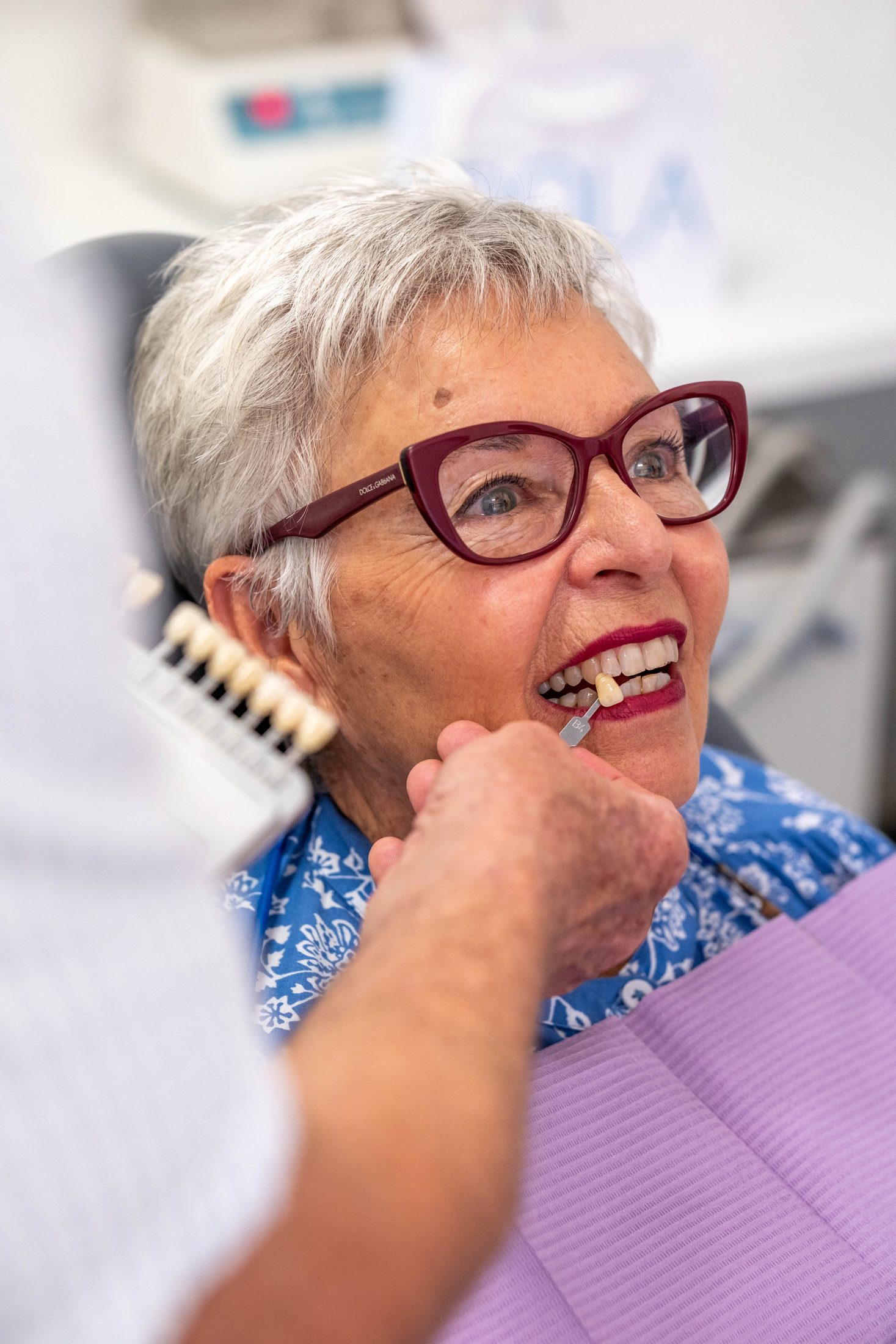
We offer both composite and porcelain veneer options tailored to each patient's smile goals and dental condition. During your consultation, our dentists will discuss suitable treatment options, expected maintenance, and long-term care to help you achieve a natural and confident smile.
Fees confirmed inyour written quote after consultation
Final cost varies with tooth count, material choice, lab work and clinical needs.
Composite and porcelain optionsConsultation-led planningExpected maintenance discussedWritten quote before treatment
Veneer materials and planning Composite and porcelain options explained before treatment
It's not usually a grand ambition. It's one specific thing — the chip that happened on a paddleboard five years ago and never quite left your mind, the tooth that's a slightly different shade after a root canal, the peg lateral that's been narrower than the others since you were fifteen, the incisor edges ground flat from years of clenching. You've looked at it, you've wondered about it, and you haven't done anything yet.
Composite and porcelain veneers are two different ways to address that one specific thing — and they suit different situations. Composite is built directly onto your tooth in a single appointment. Porcelain is crafted in a laboratory and bonded at a second visit. One has a lower entry cost and is easier to repair; the other is non-porous and has a longer documented service interval in published clinical studies. Neither is the obvious answer for everyone.
We offer both composite and porcelain veneer options tailored to each patient's smile goals and dental condition. During your consultation, our dentists will discuss suitable treatment options, expected maintenance, and long-term care to help you achieve a natural and confident smile.
If you've been thinking about this for a while, the page ahead is worth reading through. It covers candidacy, the comparison between the two options, the step-by-step process, what to know before you decide, and what it costs. By the end, you'll have enough to either book a consultation or know which question to ask when you do.
What a veneer doesto the surface of the tooth
A veneer sits over the front surface of the tooth. That's the whole idea. Here's what that means in practice — and why the preparation step matters more than most people expect.
Your natural tooth
Who plans your veneersat Chapman Road Dental, and what to expect from the consult
Your veneer consultation is handled by AHPRA-registered dentists who can discuss composite and porcelain options, expected maintenance, long-term care, and whether another treatment sequence should come first.
Dentist
Dr Jignesh Vania (Dentist)
Most of Dr Jignesh Vania (Dentist)'s veneer work comes from the same handful of situations: a chip from sport, worn incisor edges from long-term clenching, a peg lateral that has never quite matched the tooth next to it, discolouration that whitening hasn't reached. Geraldton's outdoor life — the sun, the salt, the paddleboarding — tends to produce its own version of these cases.
He works with both composite and porcelain. His starting point is always the same: photos, a digital scan of your bite, and a conversation about what you want. From that, he can tell you which option fits your situation, how many appointments it takes, what the tooth preparation involves, and what the realistic cost looks like before you commit to anything.
If your case needs something outside his scope — specialist prosthodontics for a complex reconstruction, or orthodontic assessment before veneers are appropriate — he'll tell you that at the consultation rather than proceed with something that won't serve you.
Placing composite veneers since: Composite veneer suitability discussed at consultation
Placing porcelain veneers since: Porcelain veneer suitability discussed at consultation
Consultation includes: Photos, digital scan, written treatment plan and quote
AHPRA Reg. No. DEN0002032608
For complex cases we refer out when it matters. If your situation calls for a specialist prosthodontist or an orthodontic assessment first, our dentists will discuss that at the consultation — not after you've started treatment.
What happens, step by stepfrom the consultation to the two-week review
Composite and porcelain follow different paths through the process. Here is what each stage involves so you know what you're agreeing to before you book.
01 · 60–90 minutes
You leave this appointment with a written treatment plan and a quote. That's the whole point of it.
Step 01 · The starting point
Consultation, photos, and digital scan
Before any treatment is discussed, your dentist looks at where you're starting from.
You'll come in, have a full set of clinical photos taken, and your dentist will scan your bite digitally where suitable. From that baseline they can map exactly which teeth are involved, what preparation would be needed, and how the result would sit alongside your existing teeth. You leave with a written treatment plan and a quote — not a commitment to proceed.
Clinical photos and digital bite scan
Discussion of composite vs porcelain fit for your case
Written treatment plan and quote before you decide
No obligation to proceed at this stage
02 · 30–45 minutes (porcelain) · Included in Step 01 (composite)
Whitening before veneer placement is common — porcelain won't change shade after it's bonded, so the surrounding teeth should be at the shade you want first.
Step 02 · Design and planning
Shade selection and wax-up (porcelain) or composite shade match
For porcelain, this is where the lab receives the brief. For composite, it often happens at the same visit as Step 01.
If you're going ahead with porcelain, your dentist selects the shade alongside you — matching to your adjacent teeth, factoring in any whitening you've already done or plan to do. A wax-up or digital design shows you the intended shape before preparation begins. For composite, shade matching happens chairside; the design conversation is part of the placement appointment itself.
Shade selection matched to adjacent natural teeth
Discussion of shape and edge design
Digital wax-up or mock-up for porcelain cases
Composite: shade selected chairside at placement visit
Temporary veneers protect your teeth while the lab works. They are functional but not the final result.
Step 03 · Preparation and placement
Enamel preparation and temporaries (porcelain) or chairside build (composite)
This is where the paths diverge.
For porcelain, your dentist prepares the enamel surface — removing a thin layer to make room for the shell — fits temporary veneers to protect the prepared teeth, and sends the impression or digital scan to the laboratory. The lab typically takes two to three weeks to fabricate your veneers. For composite, there's no laboratory stage — the veneers are built directly on your teeth using layered composite resin in a single visit, shaped and polished chairside to achieve the intended shade, shape, and surface finish.
Porcelain: lab fabrication period — typically 2–3 weeks
Composite: full placement and polish in a single visit
Local anaesthetic available for preparation comfort
04 · 60–90 minutes
This is the appointment composite veneer patients skip — their single visit covers what porcelain patients get across Steps 03 and 04.
Step 04 · Porcelain only
Fitting and bonding the porcelain veneers
The lab-fabricated shells arrive. This is the bonding appointment — the result you've been working toward.
Your dentist removes the temporary veneers, places the porcelain shells to check shade, fit, and bite, and makes any minor adjustments before bonding. The adhesive is cured under a dental light. Once bonded, the veneers are polished and your bite is checked across all contact points. You leave with your final result.
Fit, shade, and bite assessment before bonding
Minor adjustments made before adhesive is applied
Adhesive cured and final polish completed
Bite checked across all contact points
05 · 20–30 minutes
Your veneers are cared for the same way as your natural teeth. The maintenance commitment is a clean and check-up, not a specialist programme.
Step 05 · Follow-up
Two-week review and aftercare
A short follow-up appointment — part of the service, not an add-on.
A review after placement checks how the veneers are settling — bite, gum response, any sensitivity. It's also the appointment where you raise anything you've noticed since placement. Aftercare from here is straightforward: brush and floss as normal, attend your regular check-up and clean appointments, and avoid habits that put unnecessary load on the veneers — opening packaging with your teeth, nail-biting, or sustained contact with ice.
Bite and gum response checked at two weeks
Any sensitivity or fit concerns addressed
Aftercare habits reviewed
Regular check-ups and cleans continue as normal
Is this the right fit for you?Situations where veneers work — and where they don't
Veneers suit a specific set of situations. This section covers both — so you can work out where you stand before you book a consultation.
Veneers may suit you if:
Your tooth structure is sound and the issue is cosmetic
Mild to moderate discolouration that whitening hasn't shifted — tetracycline staining, fluorosis, or intrinsic shade differences
A chipped or fractured front tooth where the underlying structure is otherwise intact
A peg lateral or tooth that is narrower, shorter, or differently shaped than its neighbours
Minor spacing or small gaps between front teeth that don't require orthodontic movement
Worn or flattened incisor edges from long-term clenching or grinding — assessed case by case
The right candidacy check happens at your consultation — photos and a scan give your dentist what they need to tell you honestly whether veneers are the appropriate step.
Veneers aren't the first step if:
Something else needs attention before cosmetic work begins
Active tooth decay — decay needs to be treated and the tooth stabilised before any veneer is placed
Untreated gum disease — healthy gums are a requirement; the supporting tissue must be stable first
Significant crowding or bite misalignment — veneers don't move teeth; orthodontic assessment comes first
Heavy unmanaged bruxism — grinding and clenching are a risk to veneers, particularly porcelain; a management plan is needed first
Insufficient tooth structure — veneers need a sound surface to bond to; severely damaged teeth may need a different approach
If any of these apply, your dentist will tell you at the consultation and outline the appropriate treatment sequence. Treating any active issues before cosmetic work gives the veneer a stable foundation — which published clinical evidence shows is associated with better longevity outcomes.
Composite or porcelainwhat fits your situation, your budget, and your timeline
These are two different solutions with different trade-offs. Neither is the obvious upgrade. Your situation, your habits, and what you want from the result will determine which fits — and the consultation is where that decision gets made properly.
Chairside · Single visit
Composite veneers
Built directly on your tooth in a chairside appointment. No laboratory stage, no temporaries, no second visit for the result. Composite may suit patients who want a conservative option, prefer to avoid enamel preparation where possible, or want to keep their options open — composite can often be repaired chairside if chipped, and in many cases doesn't require irreversible preparation. Colour change over time is the main maintenance consideration, particularly if you drink a lot of coffee or tea. Maintenance timing varies with habits, bite forces, and oral hygiene.
Quoted after consultation
Lab-fabricated · 2–3 visits
Porcelain veneers
Crafted in a dental laboratory and bonded at a second appointment. Porcelain is non-porous — it maintains its colour across its service life and doesn't absorb staining from food, drink, or tobacco. The trade-off is the preparation step: a thin layer of enamel from the front surface of the tooth is removed to make room for the shell. This is minimal in scale — typically 0.3 to 0.7 mm — but it is irreversible. Porcelain suits patients who have considered and accepted that step, and who want a lab-fabricated result with a longer documented service interval. Published clinical studies report survival across 10–20 year follow-up periods, though individual replacement timing varies.
Quoted after consultation
Not sure yet
Bring your question to the consultation
If you're not sure which option fits your situation, that's exactly what the consultation is for. Our dentists review your photos and digital scan, talk through what you want, and give you a recommendation with a written quote — no obligation to proceed. The comparison here gives you the framework; the consultation gives you the specific answer for your teeth.
Book a consultation
How veneers are quotedafter your consultation and treatment planning
Two materials, different maintenance profiles, and a quote that depends on your teeth. Here's what determines the final fee before you decide.
Consultation-led fee factors
Composite veneersChairside · single visit · 5–8 year study periods (88–91% survival)
Quoted after consultation
Porcelain veneersLab-fabricated · 2–3 visits · 10–20yr typical service
Quoted after consultation
Health fund estimates
Whether your extras policy includes veneer treatment and what rebate applies depends on your level of cover, item numbers, and fund rules. Check your policy or call your fund before your consultation. Items classified as purely cosmetic may receive limited or no rebate.
Payment options
Payment options can be discussed once your treatment plan and written quote are clear. If a third-party payment provider is suitable, approval, limits, and current provider terms apply at the time.
Early super release — what applies
Early release of superannuation under ATO compassionate grounds applies to dental treatment that addresses pain or functional impairment — not elective cosmetic procedures. Veneers placed for cosmetic reasons do not qualify. If your situation has a functional or clinical element, discuss that directly at your consultation; our dentists can advise on what documentation ATO and your fund require.
Final cost depends on the number of teeth, the shade and shape work needed, and lab fees on porcelain. Your quote is set at consultation after photos, scan, and treatment plan.
Ready to find out what fits?
Book a consultation at Chapman Road Dental
You'll come in for photos and a digital scan. A dentist will look at your teeth, talk through what you want, and give you a written treatment plan and quote — composite or porcelain, however many teeth are involved, with the final cost worked out before you decide. Veneers often appear as the finishing layer in a planned smile makeover — but they're not always the right starting point. No pressure to proceed. Just the information to make the right call. Book a consultation → You can also explore other cosmetic options to compare what's available.
What to know before you decideVeneers aren't for everyone, and not every case is straightforward
Every person who reads this page deserves an honest account of what veneers involve. These are the things that matter before you commit.
The honest version
Veneers cover. They don't repair.
A veneer improves the appearance of the front surface of a tooth. It doesn't treat decay, fix a bite problem, or straighten alignment. If any of those things are present, they need to be addressed first — and your dentist will tell you that at the consultation, not after you've invested in treatment.
Porcelain preparation is irreversible
For porcelain veneers, a thin layer of enamel is removed from the front surface of the tooth. It is minimal in scale — typically 0.3 to 0.7 mm — but it is irreversible. Once enamel is removed, your tooth will always need a veneer or equivalent restoration. This isn't a reason not to proceed with porcelain — for the right candidate, it's a reasonable trade-off. But it's the most important thing to understand before you choose. Composite veneers in most cases require no enamel removal at all.
Neither material lasts indefinitely
Porcelain veneers are not a one-time solution. Published clinical studies report survival across 10–20 year follow-up periods — but replacement timing depends on your bite forces, bonding surface, and maintenance. Published clinical studies report composite veneer survival around 88–91% across 5–8 year study periods. Neither figure is a guarantee, and individual results vary. The long-term economics matter: composite has a lower entry cost but a shorter refresh interval; porcelain costs more upfront but has a longer documented service life before replacement is needed.
Grinding and clenching is a real risk
Parafunctional habits — grinding and clenching — put additional load on veneers. One clinical study found the risk of failure was substantially higher in patients with a bruxism habit. Fracture is the most common failure mode, and it is more common in bruxers. If you grind at night, a protective night splint may be recommended either pre-treatment or post-treatment. Wearing it matters: one study found fracture probability was substantially higher in patients who were supposed to wear a splint but didn't. Bruxism doesn't disqualify you — it changes the management plan.
A chipped porcelain veneer usually needs replacement
Composite veneers can often be repaired chairside when chipped or damaged — compatible composite material is added and polished without removing the whole veneer. Porcelain is different. If a porcelain veneer fractures, it generally requires full replacement rather than repair. This is a practical difference worth knowing: composite has a simpler repair path; porcelain's strength comes with a different set of failure consequences.
Colour stability differs between the two materials
Porcelain doesn't change shade after placement. It is non-porous — coffee, tea, wine, and tobacco don't affect it across its service life. This also means that if your surrounding natural teeth change shade after whitening or over time, the veneer stays fixed. Whitening before veneer placement is common practice for exactly this reason. Composite resin is more porous. Marginal discolouration — slight darkening at the veneer edge — is a documented complication, observed in roughly 20% of composite veneers at 7 years in one prospective study. Regular polishing at your check-up and clean appointments helps manage this.
Maintenance is straightforward, but it does matter
Veneers are cared for the same way as natural teeth — brush, floss, and attend your regular check-up and clean appointments. What determines how long they last is your bite forces, your oral hygiene, and the habits you keep around them: avoid nail-biting, opening packaging with your teeth, or biting into very hard foods with veneered teeth. Decay at the veneer margin is a known long-term risk — another reason regular check-ups are part of the commitment, not an optional extra.
Documented veneer casesplaced at Chapman Road Dental, with consent recorded
Single post-treatment images with treatment date, treating dentist, and consent noted. No paired comparisons.
Documented cases
What completed veneer cases look like at Chapman Road
Each case shown here is a single post-treatment image — no paired comparisons. Treatment date, dentist name, and patient consent are recorded against each entry in line with AHPRA advertising guidelines for cosmetic procedures.
Cases include single chipped central incisors, worn lateral edges, peg laterals, and composite colour refreshes. Tooth count, procedure type, and case duration are noted in each caption.
How cases are documented
Treatment date recorded
Treating dentist named
Patient consent confirmed
Tooth count and material noted
Case duration where applicable
Frequently askedabout porcelain veneers.
What published research says
Porcelain veneers have one of the longer evidence trails of any cosmetic dental treatment. Published clinical reviews report a 10-year cumulative survival rate of around 95% across 25 clinical studies and approximately 6,500 veneers — a figure from a systematic review published in the Journal of Clinical Medicine by Alenezi et al 2021.
The 21-year data
Layton & Walton 2012 followed 499 feldspathic veneers in 155 patients for up to 21 years and found approximately 96% cumulative survival — one of the longest prospective studies on record. Failures were rare: 17 veneers across 8 patients across the full 21-year period.
5-year and 20-year pooled data
A separate systematic review by Layton, Clarke & Walton 2012 placed 5-year pooled survival at approximately 95.7% (95% CI: 92.9–98.4%). A 20-year cohort study by Beier et al 2012 reported survival of around 94% at 5 years, 93% at 10 years, and 83% at 20 years.
What affects how long yours lasts
The bonding surface matters significantly. When porcelain is bonded to enamel, survival approaches 99% at 10 years — a key reason preserving enamel during preparation is a clinical priority. When bonding extends to dentin, survival rates are somewhat lower, around 94–95%. Beyond the bonding surface, bite forces, oral hygiene, and whether parafunctional habits like grinding are managed all influence replacement timing.
What to expect at Chapman Road Dental
These figures are study ranges, not individual guarantees. At your consultation, your dentist reviews your specific tooth condition, bite forces, and habits to give you a realistic expectation — not a figure taken from a population average.
You've thought about thislong enough. Here's what the consultation actually involves.
A veneer consultation gives you time for photos, a digital scan, a conversation about what you want, and a written treatment plan with a quote at the end. Composite or porcelain, however many teeth, whatever the situation. You leave knowing what it involves, what maintenance may be expected, and what it costs. Then you decide. Patients from Rangeway, Spalding, Beachlands, Drummond Cove, Wonthella, and across Geraldton WA are welcome — call us on 08 9964 3577 or book online.